

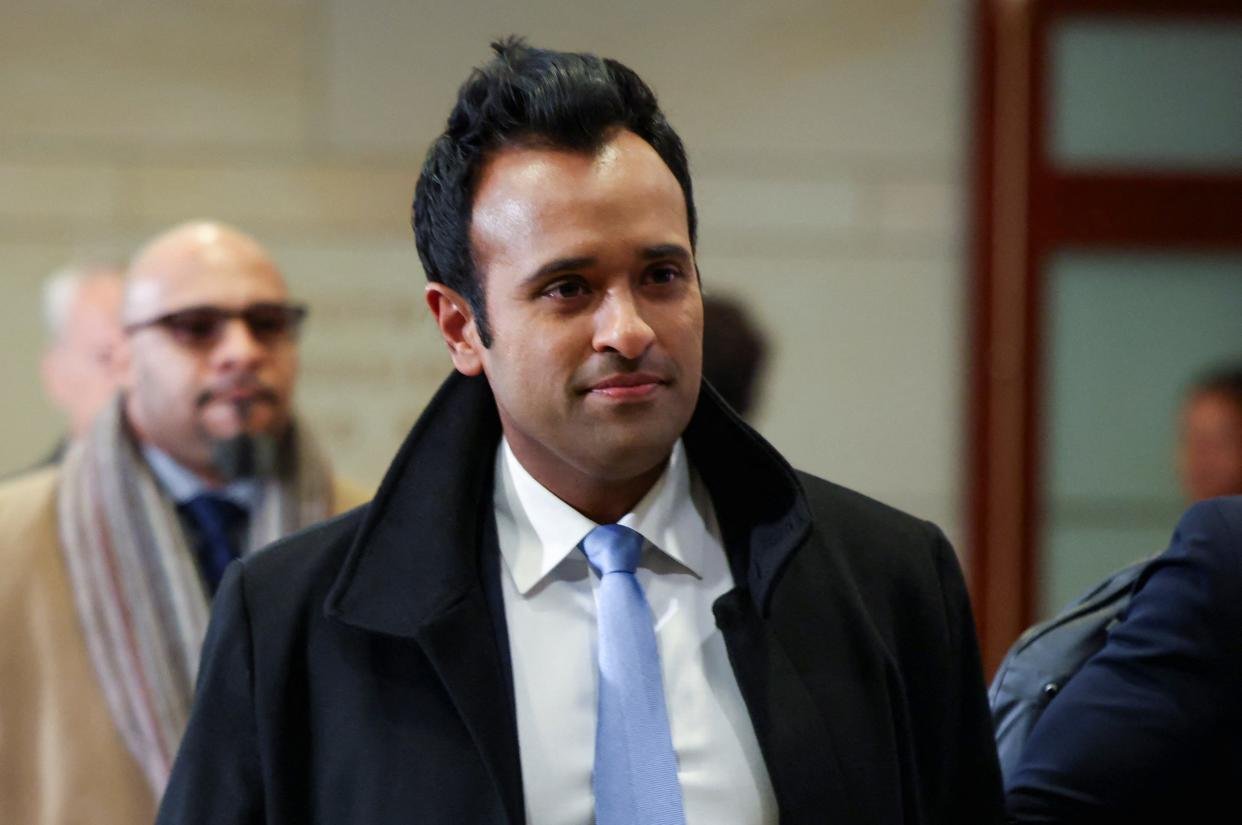

Indian-origin entrepreneur Vivek Ramaswamy has stepped down from his position in the Department of Government Efficiency (DOGE), hours after Donald Trump assumed office as the 47th President of the United States.
Ramaswamy’s departure reportedly stems from tensions with tech billionaire Elon Musk, who co-leads the task force. It also coincides with Ramaswamy’s plans to run for governor of Ohio and criticism over his comments on H-1B visas.
In a controversial tweet, Ramaswamy criticized the U.S. tech sector’s dependence on foreign workers, attributing it to a cultural bias favoring “mediocrity over excellence.” This sparked backlash within some Republican circles and reportedly influenced Musk’s desire for Ramaswamy to exit the panel.
Despite these differences, Ramaswamy had expressed optimism about working with Musk to reduce federal spending. On social media, he thanked DOGE for the opportunity and hinted at his political aspirations in Ohio, where Governor Mike DeWine is set to vacate the office in 2027 due to term limits.
A spokesperson for DOGE, Anna Kelly, commended Ramaswamy’s contributions, stating his decision to resign reflects his focus on pursuing elected office. “We are grateful for his efforts and believe he will continue to contribute to America’s progress,” Kelly said.
DOGE, a task force under Trump’s “Save America” agenda, aims to streamline federal operations, eliminate unnecessary programs, and reduce regulations. However, the panel has faced criticism, including a lawsuit alleging violations of federal transparency laws.
Musk’s leadership has also sparked concerns about conflicts of interest due to his companies’ extensive government contracts.
Separately, Ramaswamy recently criticized New York City’s decision to lease the Roosevelt Hotel, owned by Pakistan International Airlines (PIA), for $220 million to house undocumented migrants. He argued this arrangement indirectly channels taxpayer money to a foreign entity.
The hotel, featuring over 1,200 rooms, closed in 2020 due to financial difficulties and is now part of a broader financial strategy tied to Pakistan’s $1.1 billion IMF bailout.
