

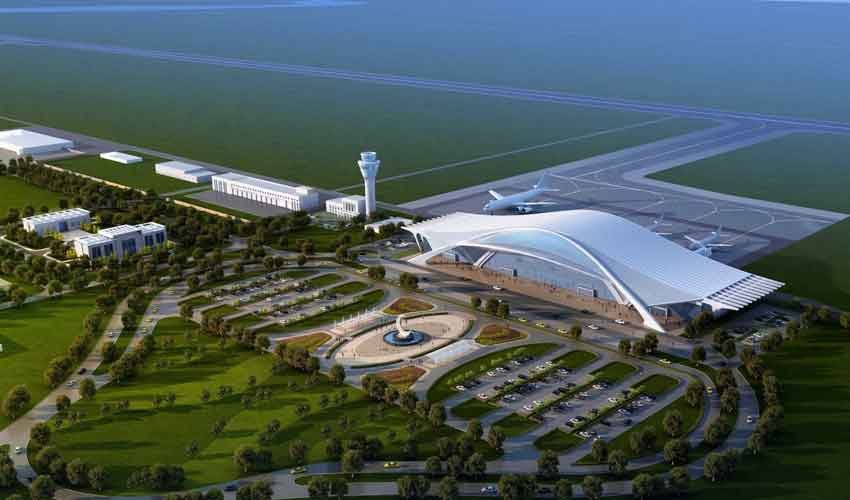

Gwadar Airport
Western media outlets, including BBC, CNN, and several Indian news organizations, have continued to propagate misleading narratives about the New Gwadar International Airport (NGIA), portraying it as a failed project and using it as a basis to undermine the success of the China-Pakistan Economic Corridor (CPEC).
These reports attempt to paint a picture of stagnation and inefficiency, reinforcing the idea that Gwadar’s development is not progressing as planned. However, a closer look at the facts on the ground presents an entirely different reality—one that is backed by investigative journalism, official records, and the undeniable progress of Gwadar’s infrastructure.
The New Gwadar International Airport, a modern aviation facility built at a cost of $230 million, spans 4,300 acres and has been fully operational since January 20, 2025. Since its inauguration, the airport has continued to expand its flight operations, demonstrating its viability as a crucial transport hub.
Over the course of just five weeks, between January 20 and February 26, the airport successfully handled 42 flights, establishing strong air connectivity between Gwadar and key domestic as well as international destinations.
Currently, the airport operates on a weekly schedule, with flights departing and arriving on Mondays, Wednesdays, and Fridays. These scheduled flights link Gwadar with Karachi and Muscat, providing essential connectivity for both business and leisure travelers.
During this period, 14 flights between Gwadar and Karachi transported a total of 542 passengers, while 7 flights between Gwadar and Muscat carried 299 passengers.
Additionally, flights arriving from Karachi to Gwadar brought in 493 passengers, whereas those arriving from Muscat accounted for 203 passengers. Altogether, NGIA has facilitated the movement of 1,537 passengers in its initial weeks of commercial operations.
These figures stand in stark contrast to the claims made by detractors who continue to push the narrative of Gwadar’s supposed failure. The reality is that Gwadar is making steady progress, and NGIA is playing a significant role in integrating the city into both regional and global air networks.
The consistent increase in flight activity underscores the growing importance of the airport and its role in enhancing economic and trade opportunities under the broader CPEC initiative.
Despite repeated attempts by hostile entities to discredit Gwadar’s development, the tangible progress on the ground speaks for itself. The increasing connectivity, rising passenger movement, and expanding operational capacity of NGIA all serve as proof that the airport is far from being a failure.
Instead, it is becoming a vital component of Pakistan’s economic future, defying propaganda and solidifying Gwadar’s role as an emerging economic hub.
